If there is one thing building a unit has taught me, it's that the seemingly easy things can take a long time for a perfectionist (i.e. me). Finding a rubric is perhaps the strongest example of this, considering I have spent way more time on this than should have been necessary, even though I had initially counted it as a simple 30-minute undertaking.
In my research, I found a lot of rubrics that I thought were okay, none that I thought were truly awful, none I found perfect, and, of course, none that fit my unit. As a jumping off point, I decided to look at rubrics for essays. As an aspiring English teacher, I figure essays will be an unavoidable part of each and all of my classes. Along the way, I also found the Teachers Pay Teachers website, which will likely see a lot of use from me. Even if you're not looking to buy resources, it can be a great source of ideas and inspiration (and some free stuff, as well).
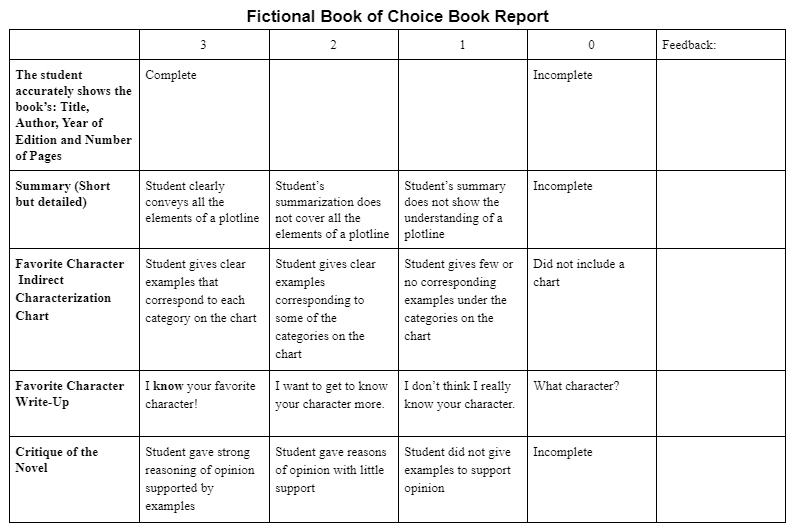
The first rubric I found had some positive aspects but was not one I would use. It was succinct, able to fit on a single page, and had a clear escalation from 1 to 3 points. I especially appreciated that this rubric had a column for feedback. There are negative aspects as well, which would need to be remedied before I would consider emulating the rubric. The categories, while clear in their expectations, are not clearly connected to any standards. The requirements for each category, while having a clear escalation, do not all seem easily measurable. I could see how the summary and characterization charts might be quantifiable, but the favorite character write-up seems entirely subjective. I believe student work should be judged by its effectiveness rather than arbitrary numbers, but if the work is to be given a grade (which is, itself, a numerical value), there must be some way to quantify the effectiveness.
I did find a rubric for an argumentative essay that I felt was mostly well built. I appreciate how this rubric characterizes the levels of meeting the standard, with the exception of "inadequate." If I were to use this rubric, I would want to combine the 1 and 2 point columns, both to make it fit a 1-4 scale and to eliminate the label of "inadequate." In the place of this column, I might put a feedback column, as was featured in the previous rubric.
This rubric conforms very closely to the standards without simply copying and pasting the standards, a balance I've struggled with a bit myself. The creator of the rubric did put the standards on the back of this rubric, making them accessible to the students. Each category has a heading, making it clear what is important, and includes a description of what this means. While this does make the rubric a bit wordy, this can be a benefit as much as a drawback. Students may not want to read a rubric with so many words, but those that do understand the clear expectations for the assignment. A wordy rubric also helps the teacher while grading, as he or she can underline the relevant level of proficiency the student met.

In my research, I found a lot of rubrics that I thought were okay, none that I thought were truly awful, none I found perfect, and, of course, none that fit my unit. As a jumping off point, I decided to look at rubrics for essays. As an aspiring English teacher, I figure essays will be an unavoidable part of each and all of my classes. Along the way, I also found the Teachers Pay Teachers website, which will likely see a lot of use from me. Even if you're not looking to buy resources, it can be a great source of ideas and inspiration (and some free stuff, as well).
The first rubric I found had some positive aspects but was not one I would use. It was succinct, able to fit on a single page, and had a clear escalation from 1 to 3 points. I especially appreciated that this rubric had a column for feedback. There are negative aspects as well, which would need to be remedied before I would consider emulating the rubric. The categories, while clear in their expectations, are not clearly connected to any standards. The requirements for each category, while having a clear escalation, do not all seem easily measurable. I could see how the summary and characterization charts might be quantifiable, but the favorite character write-up seems entirely subjective. I believe student work should be judged by its effectiveness rather than arbitrary numbers, but if the work is to be given a grade (which is, itself, a numerical value), there must be some way to quantify the effectiveness.
I did find a rubric for an argumentative essay that I felt was mostly well built. I appreciate how this rubric characterizes the levels of meeting the standard, with the exception of "inadequate." If I were to use this rubric, I would want to combine the 1 and 2 point columns, both to make it fit a 1-4 scale and to eliminate the label of "inadequate." In the place of this column, I might put a feedback column, as was featured in the previous rubric.
This rubric conforms very closely to the standards without simply copying and pasting the standards, a balance I've struggled with a bit myself. The creator of the rubric did put the standards on the back of this rubric, making them accessible to the students. Each category has a heading, making it clear what is important, and includes a description of what this means. While this does make the rubric a bit wordy, this can be a benefit as much as a drawback. Students may not want to read a rubric with so many words, but those that do understand the clear expectations for the assignment. A wordy rubric also helps the teacher while grading, as he or she can underline the relevant level of proficiency the student met.

Comments
Post a Comment